
Paw-picked Facts You Didn’t Know You Needed
Cats are weird. They’re mysterious, independent, and somehow manage to be both the laziest and most chaotic creatures on the planet. But that’s what makes them so fascinating. Whether they’re ignoring you for hours or suddenly deciding that your laptop is their new favorite spot, cats have a way of capturing our attention and keeping it. Ready to learn a few cat facts that might totally blow your mind... or, you know, just mildly entertain you while you waste time? Either way, let’s go.
Did you know that there are numerous cat facts that can amaze you? Cat facts can be surprisingly interesting, revealing the unique traits and behaviors of our feline friends. Let's dive into some incredible cat facts!
Here are some cat facts that can amaze you. Cat facts can be surprisingly interesting, revealing the unique traits and behaviors of our feline friends. Let's dive into some incredible cat facts!
Prepare to be amazed by the myriad of cat facts that reveal the charm and personality of our feline companions!
Fascinating Feline Biology
The Healing Powers of Purring
In this post, you'll discover some of the most intriguing cat facts out there that will deepen your appreciation for these marvelous creatures.
Here are some amazing cat facts: Cats can make over 100 different sounds, and their noses are as unique as human fingerprints. These unique cat facts enhance our understanding of these beloved pets.
We all know the sound of a cat purring. It’s the ultimate sign of contentment, right? But here's the thing: it’s not just a cute noise to make you feel warm and fuzzy inside. Cats’ purring actually serves some pretty powerful purposes.
So, prepare to be amazed by these cat facts: A group of cats, often called a clowder, can be found lounging together, showcasing their quirks and charm. These cat facts will make you see them in a whole new light!
Healing Vibes: A cat’s purring, which vibrates between 25–150 Hertz, is linked to healing benefits such as promoting bone growth, reducing inflammation and pain, and lowering stress.
In addition to being adorable, cats exhibit fascinating behaviors. Here are more fun cat facts: A group of cats is called a clowder, and they sleep for about 13-16 hours a day. Such cat facts make them even more remarkable!
Now that we've covered some basic cat facts, let's delve into the peculiarities of their behavior and personality.
So, next time your cat is curled up on your lap purring away, know that they’re doing more than just making you feel loved. Cat facts reveal that they’re healing, and they’re making you feel better too!
Self-Soothing: Cats also purr to calm themselves down when they’re stressed or injured, which helps them recover from things like anxiety or pain.
Bonding: When your cat purrs at you, it’s not just about them feeling good. It’s a way to strengthen the bond between the two of you. In fact, a cat’s purr has been shown to lower heart rates and blood pressure in humans, which is basically a win-win situation.
So, next time your cat is curled up on your lap purring away, know that they’re doing more than just making you feel loved, they’re healing, and they’re making you feel better too!
Cats' Retractable Claws: Nature’s Advantage
If you’ve ever caught your cat mid-pounce or watched them playfully “climb” your curtains, you’ve probably seen those sharp, retractable claws in action. But these claws are more than just weapons of destruction. They’re an essential tool for survival.
Climbing and Hunting: Cats use their claws for climbing trees, scaling walls, and hunting prey. When fully extended, their claws give them grip and leverage, allowing them to reach high places or catch fleeing prey with ease.
Self-Defense: Those claws also act as their primary form of self-defense. When a cat feels threatened, they can swipe out their claws in an instant, making them formidable opponents in a fight.
Now let's explore some of the weirdest cat facts you never knew, shedding light on the fascinating world of cats!
Marking Territory: Cats are territorial creatures, and they often use their claws to mark their space. Whether it's a post, a couch, or even your favorite chair, they’ll scratch to leave their scent and show who’s in charge.
Rest Mode: The cool part about retractable claws is that when they’re not in use, they retract back into the paw, which helps keep them sharp and out of the way. This also prevents them from getting snagged on things like your favorite sweater or, you know, your face.
So, when your cat digs into your furniture or leaves scratches on the walls, just remember, it’s all part of their clever design for survival and self-expression. Those little daggers aren’t just there to cause chaos; they’re vital tools that help your cat climb, hunt, and defend themselves.
The Secret of Whiskers
As you read through these cat facts, pay attention to how their social behaviors can tell you much about their character.
Whiskers. They’re those long, twitchy hairs on your cat’s face, and let’s be honest, they’re adorable. But they’re also a lot more important than you probably realized. These sensitive little sensors are like a cat’s very own GPS system.
Sensory Radar: Whiskers help cats gauge the size of openings and measure whether they can fit through tight spaces. If you’ve ever watched your cat try to squeeze through an impossibly small gap, it’s the whiskers doing the hard work.
Proximity Detector: The whiskers are also extremely sensitive to air currents, which helps cats detect movement around them, like when a mouse is scampering just out of view.
Balance and Orientation: Whiskers also play a crucial role in helping cats keep their balance. Whether they’re high up on a ledge or flying through the air after a toy, their whiskers give them a sense of where they are in space.
Each cat's nose is distinct, much like their personalities. The uniqueness of a cat's nose is just one of the many cat facts that highlight their individuality.
Reading Emotional Cues: A cat’s whiskers reflect its mood pushed forward when excited or hunting, and pulled back when relaxed. Their movement can even hint at the cat’s next action.
Whiskers are highly sensitive tools that help cats sense their surroundings and avoid obstacles. They also express emotion, moving based on a cat’s mood, like fanning out when alert or excited. This makes whiskers vital to a cat’s agility, awareness, and communication.
The Unique Nose: Like a Fingerprint!
Move over, humans, because your cat’s nose is something special. While we may think our noses are pretty great, cats are on a whole different level.
Unique Like a Fingerprint: Each cat’s nose has a pattern, much like a human fingerprint. In fact, no two cats’ noses are exactly alike. So if you’re ever in doubt about your cat’s identity, just take a look at their nose. It’s as unique as they are.
Super-Sensitive Smell: Cats have a sense of smell that’s about 14 times more powerful than ours. That means they can sniff out things that we can’t even imagine. Here’s what they use it for:
- Finding food: Cats can track down their favorite snack from across the room or across the house.
- Recognizing people: A cat can recognize their owner by scent alone. So if they greet you at the door with their nose twitching, it’s because they already know it’s you
- Safety: A cat’s nose helps them detect changes in their environment, like whether someone or something is approaching. It’s their personal security system.
Furthermore, these cat facts will amaze you with their exceptional sensory abilities and agility.
Scent as Communication: Cats also use scent to communicate. Ever notice your cat sniffing around before settling in somewhere? They’re not just being nosy; they’re learning about the space and marking it as their own.
So next time your cat gives you that sniffing “hello,” just know they’ve already got all the information they need about you and probably a few secrets of their own.
Cats' Super Sensory Powers
Cats are pretty much superheroes when it comes to their senses. Not only do they have extraordinary vision and hearing, but their ability to touch, balance, and even detect the faintest vibrations is out of this world.
Night Vision: Cats have excellent night vision, capable of seeing in near-total darkness. That means they can navigate around the house while you’re stumbling around in the dark trying to find your phone.
Super Hearing: Cats can hear sounds at frequencies between 48 Hz and 85 kHz. Way higher than humans. They can pick up on the faintest of noises, so when they suddenly perk up at nothing, they’re hearing something you probably can’t.
So, are you ready for a deep dive into the world of cat facts? Let’s discover more!
Balance Like a Boss: Cats are also experts at balancing. Their inner ear structure helps them stay steady even in the most precarious situations, which is why they can leap from high places or land on their feet with near-perfect precision.
Tactile Sensitivity: Cats are so sensitive to touch that their paws can feel tiny vibrations and subtle changes in the air, which helps them hunt, communicate, and figure out what’s going on around them.
Cats seem mysterious because their powerful senses like night vision, sharp hearing, and agility let them experience a world beyond human perception.
“Cats are connoisseurs of comfort.”
– James Herriot
Cats and Their Unique Personalities
The Cat Who Doesn’t Like Belly Rubs
Ah, the belly rub, a classic invitation from dogs, but for cats? It’s often a trap. Sure, they might roll over and expose their fluffy undercarriage, but the second you move in, you’ll meet the sharp end of their disapproval (read: claws). Why don’t most cats like belly rubs?
Instincts: A cat’s belly is one of their most vulnerable spots. In the wild, exposing it could mean doom if they’re attacked. So, when you go for the tummy, their survival instincts kick in.
Nerve Sensitivity: Cats’ bellies are packed with nerve endings, which means a belly rub can go from “ahh” to “argh!” in 0.2 seconds.
Personal Preference: Some cats do love belly rubs! But for most, it's a personal boundary and we all know cats are the queens and kings of enforcing their boundaries.
Pro tip: If your cat rolls over and shows their belly, admire it from a respectful distance unless you’ve received explicit written consent (or, you know, a lack of swatting).
Can Cats Really Ignore Us on Purpose?
Let’s get one thing straight: cats hear you. Oh, they definitely hear you. But whether they choose to acknowledge you? That’s another story. Here’s why cats often seem to ignore us:
Selective Attention: Research shows cats are highly attuned to their names but often don’t respond because… well, they just don’t feel like it. They’re not here to impress anyone.
From their unique instincts to their playful antics, these cat facts will deepen your appreciation for your furry friend.
Independence Overload: Unlike dogs, who have been bred for thousands of years to respond to commands, cats domesticated themselves (really). They see humans as equals. Sometimes even as subordinates.
Psychological Game: Cats might ignore you because they know it drives you crazy. Ever notice how they suddenly want your attention when you’re busy? Yep, it’s all part of the game.
Mood-Based Responses: Cats are masters of doing things on their own terms. If they’re in the mood for attention, they’ll let you know. If not, they’ll act like you don’t exist until it’s time for food, of course.
So, the next time your cat stares at you like you’re a mildly interesting documentary, remember: they’re choosing to ignore you, and it’s entirely intentional. It’s not that they don’t care, they just prefer to keep you on your toes. After all, what’s the fun in being predictable when they can keep you guessing instead?
Cats Can Learn Tricks but They’re Not Showing Off
These cat facts show just how unique and captivating cats truly are. From their quirky personalities to their supernatural abilities, cat facts are endlessly entertaining.
Dogs may hog the spotlight with their sit, stay, and roll-over routines, but cats are no less capable of learning tricks, they just prefer to keep their talents under wraps.
What can cats learn?
- Basic Commands: With patience and treats, cats can learn to sit, shake paws, and even high-five.
- Advanced Skills: Some cats have mastered leash-walking, jumping through hoops, or even ringing a bell for food.
- Object Tricks: Fetch? Yes, some cats will fetch (especially if they think it’s their idea).
Why don’t they show off?
- Motivation Matters: Cats need a reason to perform usually food, play, or sheer curiosity. They don’t see the point of impressing you unless there’s something in it for them.
- Short Attention Span: Cats get bored quickly, so training sessions need to be brief and fun.
So, if your cat learns to sit on command, don’t expect them to repeat it for Aunt Carol at Thanksgiving dinner. They’ve got standards.
How Cats Respond to Human Emotions
Cats might act aloof, but they’re surprisingly tuned in to how we’re feeling. In fact, studies show they can pick up on our emotions and react in subtle ways.
Happy Vibes: When you’re in a good mood, your cat might become more playful, affectionate, or even mimic your energy.
Sad Days: Cats have been known to comfort their humans when they’re upset by sitting near them, purring, or simply staying close.
Stress Detectors: If you’re stressed, your cat might pick up on it and act differently, too. Some become clingy, while others might distance themselves.
While cats may not wag their tails or slobber on you like a dog, their quiet emotional intelligence is just as powerful. They know when you need them even if their version of “helping” is staring at you from the couch.
“A cat is a puzzle for which there is no solution.”
– Hazel Nicholson
Cats in History & Culture
Worshipped in Ancient Egypt: The Sacred Cat
If there was ever a golden age for cats, it was Ancient Egypt. Cats weren’t just cute companions; they were straight-up divine. Known as Mau (which is honestly adorable), cats were considered sacred animals, embodying the goddess Bastet, protector of home, fertility, and, naturally, all things feline.
Why were they so revered?
Guardians of the Grain: Cats protected Egypt’s most valuable resource grain by hunting mice and rats.
Symbol of Protection: Bastet was often depicted as a lioness or a domestic cat, symbolizing protection and nurturing. Owning a cat was like having a spiritual bodyguard.
Royal Treatment: Families mourned their cats deeply, sometimes even shaving their eyebrows in grief (yes, you read that right). Cats were often mummified and buried alongside their humans, a true testament to their VIP status.
Fun Fact: Killing a cat in Ancient Egypt whether accidental or intentional was punishable by death. Talk about ultimate cat privilege.
Lucky Charms: The Japanese Maneki-neko
Ever seen a little ceramic cat waving at you from a shop window? That’s the Maneki-neko, or “beckoning cat,” a popular symbol of good fortune in Japan.
Origins: The legend of Maneki-neko dates back to the Edo period, where a cat supposedly saved a lord’s life by beckoning him into a temple just before lightning struck the spot where he’d been standing.
Meaning of the Paw: A raised right paw invites wealth, while the left paw invites customers. Double the paws, double the luck!
Color Matters: Each Maneki-neko color has a specific meaning. White symbolizes happiness, black wards off evil spirits, and gold? That’s all about the money.
You may not have a temple cat guiding you, but a Maneki-neko might just bring some good vibes to your home or business.
Medieval Myths: The Magic of Cats
The Middle Ages weren’t exactly a fun time for cats. Thanks to their mysterious behavior and nocturnal habits, cats especially black ones, were often associated with witches and the supernatural.
Cats as Witch Companions: Folklore claimed that witches could shape-shift into cats to carry out their dark deeds. Some even believed cats were witches in disguise, roaming the streets to spy on humans. Spooky.
Bad Luck Myth: Crossing paths with a black cat was thought to bring misfortune, a superstition that still lingers today in some places.
Ironically, cats were feared for their independence and intelligence traits we now admire. Medieval cats probably would’ve rolled their eyes (if they could) at the absurdity of it all.
The Dark Ages and the Fear of Cats
Here’s a dark twist: during the plague-ridden years of the Black Death, cats were targeted as carriers of evil. Large numbers were killed, under the belief that they were spreading disease.
Plot twist: It wasn’t the cats but the rats (and their flea passengers) that spread the plague. Fewer cats meant more rats, making the situation worse. Whoops.
This tragic episode serves as a grim reminder: never underestimate the value of a good mouser.
The Cat’s Role in Ancient Society
In ancient Rome, cats were celebrated as protectors of households and symbols of freedom. Roman soldiers would bring cats along during campaigns to keep their camps free of pests. Talk about practical travel companions. But cats weren’t just working animals, they were loved. Roman mosaics, frescoes, and even graffiti celebrated these feline friends. One famous mosaic, “Cave Canem” (Beware of Dog), features a cat casually sneaking by. Classic cat behavior.
Similarly, in ancient Egypt, cats were revered almost to the point of worship. The goddess Bastet, depicted as a lioness or a woman with a cat head, symbolized home, fertility, and protection. Killing a cat, even accidentally, was considered a grave offense. Cats’ natural hunting abilities made them invaluable in protecting food stores from rodents, further cementing their revered role in Egyptian society.
However, as time progressed, the perception of cats shifted. During the Middle Ages, they became associated with witchcraft and superstition, often feared and persecuted. Cats were believed to be witches’ familiars, and many faced violence or neglect as a result. Despite this dark period, cats quietly survived in the shadows, their reputation waiting to bounce back in later centuries, where they would again be embraced as loyal companions and beloved pets.
“Cats choose us; we don’t own them.”
– Kristin Cast
Fun and Quirky Cat Facts
A Group of Cats is a “Clowder” And Other Cool Terms
Cats have their own secret vocabulary, and honestly, it’s as fancy as you’d expect from creatures that act like royalty. Did you know?
- A group of cats is called a clowder. (Try saying it aloud, it sounds like a medieval gathering.)
- Two cats closely bonded? That’s a pair. Romantic, isn’t it?
- Kittens in a litter? A kindle, because of course baby cats get the cutest word ever.
And here’s a fun one: a male cat is a tom, while an unspayed female is a queen. Yes, your cat might actually be a queen, and yes, they know it.
Cats’ Love for Naps
If you thought your cat was sleeping their life away, you’re absolutely right. The average cat sleeps 12–16 hours a day, meaning they spend about 70% of their lives snoozing. But why so much napping?
Conserving Energy: Cats are natural predators. In the wild, all that hunting and pouncing requires bursts of energy. Napping helps them recharge.
Dreamland: Cats experience REM sleep, so if you’ve ever seen your kitty twitching or softly chirping while asleep, they’re probably dreaming. (About catching mice? Or maybe about world domination?)
Safe Spot Required: Cats only sleep deeply when they feel safe. So, if your cat is snuggled up next to you, consider it a high honor.
Fun Fact: Some cats adopt the wildest sleeping positions: upside down, sprawled across your keyboard, or even balancing precariously on a ledge. Why? Because they can.
The Oldest Cat Ever - Guinness World Record Holder
Move over, Methuselah, Creme Puff, a Texas-based tabby, holds the record for the oldest cat ever, living a staggering 38 years and 3 days. That’s nearly double the average cat lifespan!
- Born: August 3, 1967
- Died: August 6, 2005
- What was Creme Puff’s secret to longevity? Her owner claimed it was a diet of dry cat food, supplemented with... wait for it... broccoli, eggs, turkey bacon, and coffee with cream. (Don’t try this at home, folks.)
Other feline elders include Scooter, the oldest Siamese at 30, and Rubble, a British Maine Coon mix who reached 31. It seems cats have their own fountain of youth, though it’s probably hidden somewhere they won’t tell us about.
The High-Jumping Cats
Ever seen your cat effortlessly leap onto a surface that seems impossibly high? It’s no magic trick, cats are built for it.
- Cats can jump up to six times their body length in a single bound. That’s like a human jumping onto the roof of a house.
- Their powerful back leg muscles provide the thrust, while their tails help them maintain balance mid-air.
- Fun Challenge: Measure how high your cat can jump by enticing them with a treat or toy. Just don’t be surprised if they outperform your expectations (or completely ignore the game altogether).
Cats might not fly, but their jumping abilities are pretty close to superhero-level feats.
Feeling like a certified cat factologist? You’re officially prepared to dazzle your friends at your next trivia night (or cat meme party). Ready to dive deeper into the mysterious world of feline intelligence? Let’s go!
“Time spent with cats is never wasted.”
– Sigmund Freud
Cats and the Internet
The Birth of the First Viral Cat Video
It all started in 2006 with a modest 17-second video that would go down in history: “Pajamas Cat”. The short clip showed a curious cat batting at a camera, and it was uploaded to YouTube by a user who didn't realize they were about to change the internet forever. This was the humble beginning of cat videos becoming a staple in online entertainment.
However, it was Charlie Schmidt's Keyboard Cat that truly launched the craze. It featured a cat named Fatso, with his paws placed on a keyboard, seemingly playing a tune. This meme quickly spread across the early days of social media and became a viral sensation, proving that cats didn’t need to do much to get the world's attention. Just a little bit of piano-playing talent (even if it was just for comedic effect) and boom, instant fame.
The Internet’s Favorite Creatures
Cats are memes, and memes are cats. There's something about our feline friends that make them the perfect canvas for humor. Here's why cats dominate online spaces:
- Expressive Faces: Cats have an arsenal of emotions that can be easily translated into meme form. From looking annoyed at a toy to peering suspiciously at their humans, cats provide endless content.
- Unexpected Humor: Cats are curious and often find themselves in ridiculous situations, like getting stuck in boxes or unexpectedly pouncing on their own reflection.
- Relatable Behavior: We all know that one cat who stubbornly refuses to let you sit on the couch. Their charming, unpredictable nature provides endless opportunities for laughs.
But why exactly do cats explode into memes? It’s all about timing. Cats seem to appear at the perfect moment, whether it's delivering a well-timed stare or caught mid-antics.
Nyan Cat, Grumpy Cat, and Other Icons
Internet-famous cats like Nyan Cat, Grumpy Cat, and Lil Bub have not only entertained millions but also made significant contributions to animal welfare:
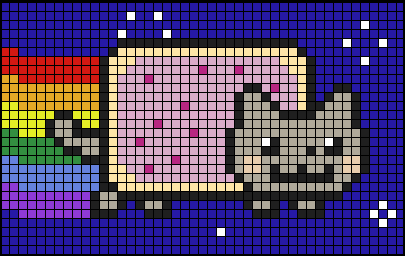
Nyan Cat: This pixelated, flying cat with a Pop-Tart body and a rainbow trail became a viral meme in 2011, amassing over 100 million views. Its catchy tune and quirky animation captured the internet's imagination.
Grumpy Cat: Known for her perpetual frown, Tardar Sauce, aka Grumpy Cat, rose to fame in 2012. Beyond spawning countless memes and merchandise, Grumpy Cat's popularity helped raise awareness for animal adoption and homelessness. She participated in various fundraising efforts, supporting animal rescues and charities.
Lil Bub: Born with unique genetic conditions, including dwarfism and osteopetrosis, Lil Bub's distinctive appearance and protruding tongue made her an internet sensation. More importantly, she became an advocate for special-needs pets. Through "Lil BUB's Big FUND," she raised over $500,000 for animals in need, supporting numerous animal welfare organizations.
These feline icons have not only shaped internet culture but also leveraged their fame to support animal welfare initiatives, demonstrating the positive impact of internet celebrities in real-world causes.
Learn more about famous internet cats on our Celebrity Cats page, featuring profiles, facts, and their impact on online culture.
The Most Viral Cat Memes of All Time
Let's take a moment to appreciate the top viral cat memes that have shaped our internet culture:
Ceiling Cat: The meme showing a cat peering down from a ceiling panel, implying that the cat is always watching. This image has since become a symbol for the internet’s surveillance culture. Partially creepy, mostly hilarious.
Longcat: A cat stretched out seemingly forever, this meme gained popularity for its absurd length and its almost existential depiction of feline grace and clumsiness.
Cats Saying “No”: One of the most delightful and hilarious cat moments that’s sparked a wave of copycat videos: a cat literally saying “no” in its most sassy tone.
Henlo, Fren Cat: A cat offering its greeting in adorable, misspelled English. This meme went viral for being so impossibly cute that it became a way for the internet to express pure, unbridled joy.
“A meow massages the heart.”
– Stuart McMillan
Cat Mythbusters
Cats Always Land on Their Feet. Not Always!
Ah, the classic myth: cats are perfect acrobats, always landing on their feet. Well, this isn’t exactly true, though it’s based on some solid science. Cats do have an incredible ability to right themselves in mid-air, thanks to something called the righting reflex, which helps them land on their feet after a fall. But it’s not foolproof.
What’s the catch? If a cat falls from too low a height (say, from a couch or a windowsill that’s close to the ground), they don’t have enough time to rotate and land properly. This is why cats often have accidents when they try to jump too soon or miscalculate their landing.
The myth’s origin: Cats have a flexible spine and an inner ear that helps them orient themselves mid-fall. However, they can still get injured. So, always make sure your windows have safety screens or barriers to protect them!
So, while the idea that cats always land on their feet is backed by some real-world flexibility, it's more myth than fact in certain situations.
Cats Hate Water, But Some Love It!
We’ve all heard the saying: “Cats hate water.” And while it’s often true that many cats will avoid getting wet at all costs (they don’t enjoy the soggy feeling or the after-bath grooming session), there are exceptions to this rule.
A surprising twist: Some cats love water. Yes, you read that right. Breeds like the Turkish Van are famously known for their love of swimming. These cats will happily splash around in water, and some even enjoy dunking their paws into the sink or bath.
Why? It’s thought that these water-loving cats have a natural attraction to it, with some experts saying their history as fishermen’s cats may have contributed to their aquatic preferences.
But why most cats avoid it? Most cats dislike being submerged in water because their fur becomes waterlogged, and it interferes with their ability to regulate body temperature. Plus, wet fur doesn’t feel as cozy as dry fur!
So, while your domestic tabby might not want to take a swim anytime soon, there are definitely cats out there who’ll happily dive in.
Cats’ Eyes Glow in the Dark, Sort of…
You’ve probably seen it: a cat’s eyes glowing eerily in the dark. Creepy, right? But here’s the thing, cats’ eyes don’t actually glow. Instead, they have a special reflective layer behind their retinas called the tapetum lucidum, which enhances their night vision. This layer acts like a mirror, bouncing light that passes through the retina back into their eyes, helping them see better in low light.
The glow factor: When light hits a cat’s eyes in the dark, it reflects off this layer, making their eyes appear to glow. The color of the glow depends on the cat’s genetics and the type of light source used. Usually, it’s green or yellow, but it can vary.
Why it’s awesome: This unique adaptation allows cats to see in much lower light than humans, helping them stalk prey during dawn or dusk.
So while it may look like your cat is secretly plotting something evil in the dark, they're just using their built-in night vision.
Why Cats Purr (And It’s Not Always Happiness)
Purring is one of the most beloved cat sounds, but it’s not always a sign of contentment. Cats purr when they’re happy, yes, but also when they’re stressed, scared, or even in pain.
Comfort and calm: When a cat purrs while snuggling or enjoying a meal, it’s a sign of contentment. However, when they’re under stress, such as during a vet visit or a thunderstorm, they may also purr to comfort themselves.
Healing powers: Believe it or not, purring may have healing properties. The frequency of a cat’s purring (between 25 and 150 Hertz) is said to stimulate the production of growth factors, which can promote tissue regeneration and bone healing. There’s even research suggesting that the sound frequency helps relieve pain and inflammation.
A survival mechanism: Cats might also purr to keep themselves calm in stressful situations, helping them maintain composure and avoid detection by predators when they're feeling vulnerable.
So, while a cat’s purring is often a sign of affection, it can also be a form of self-soothing and self-healing.
The Weirdest Cat Facts You Never Knew
- Cats can make over 100 different sounds (compared to dogs, who only make about 10). So next time your cat is meowing at you for attention, just remember: they're multilingual!
- Cats’ noses are as unique as human fingerprints. No two cats have the same nose print. It’s like their very own personal ID badge!
- A cat’s brain is 90% similar to a human’s brain. No wonder we can’t get enough of them, they’re practically our fuzzy counterparts!
- Some cats can jump up to six times their body length. That's like a human jumping over a school bus!
- Cats have five toes on their front paws, but only four on the back paws. It’s their little feline quirk!
- A cat’s whiskers are as sensitive as our fingertips. They use them to measure the width of openings and help with navigation, even in the dark.
- The world’s largest cat measured over 48 inches in length. Talk about a BIG kitty!
- Cats sleep between 12-16 hours a day. It’s like they’re living the dream we all wish we could.
“What greater gift than the love of a cat?”
– Charles Dickens
The Feline Phenomenon
Final Thoughts on Why We Love Cats
Let’s be real: cats are the ultimate companions. Whether they’re curling up beside you during a lazy afternoon, making you laugh with their goofy antics, or giving you that perfectly timed side-eye, cats have an uncanny ability to make our lives better. They’ve earned their place as the rulers of the internet and our hearts and, honestly, who could argue with that?
Cats don’t ask for much, just a few treats, a comfy spot on the couch, and maybe a little bit of attention when they demand it. But in return, they offer a love that’s unmatched and entertainment that never ends. They’re independent yet affectionate, calm yet playful, and always a little bit mysterious. In short, cats are everything we need in a pet, and more.
So, while this post may have ended, your journey with cats is far from over. They’re everywhere, in our homes, on our screens, and in our hearts. And whether you’re learning more about their fascinating biology or just enjoying a meme, one thing is for sure: cats are here to stay.
Looking for More Cat Content?
Let’s not forget about the quirky behaviors—these cat facts show how much they can surprise us.
If you enjoyed these facts, you’ll love exploring the rest of Cats of the Web: your go-to hub for internet-famous cats, fun feline trivia, photo galleries, and cat culture. Browse our detailed Celebrity Cats profiles or check out the Cats of the Web Shop for cat-themed merch curated just for fans. There’s always something new for curious cat lovers.
Ultimately, embracing these cat facts allows us to connect more deeply with our feline companions, appreciating their quirks and charm. So whenever you encounter cat facts, remember, they are not just amusing tidbits; they deepen our bond with these enigmatic creatures.